

An opinion piece on public money, a Visakhapatnam hilltop, and the questions that remain unanswered
A resort, a palace, or something in between?

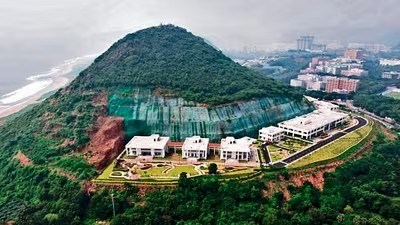
On a hill above the Bay of Bengal in Visakhapatnam sits one of the most expensive and least used buildings in Andhra Pradesh. Officially, it was a tourism project: a rebuild of the old APTDC Haritha Resort at Rushikonda. To the Telugu Desam Party and its allies, it was a sea-facing “palace” meant for then Chief Minister Y.S. Jagan Mohan Reddy, who had designated Visakhapatnam as an executive capital. The YSRCP rejects that and says the buildings are government-owned assets, not private property.
This piece does not need to settle the argument over intent. The more important question is what taxpayers paid, what they got, and what they are still paying. On those, the record is uncomfortable for the YSRCP government.
The numbers do not add up
When the project received Coastal Regulation Zone clearance in 2021, its cost was put at Rs 240 crore: Rs 92 crore for site preparation and roads, and Rs 148 crore for buildings. That is the number the public was given.
Since then, the figures have only grown.
- Rs 356.4 crore is the estimate in official state records, as reported by The News Minute. Even this is almost 50 per cent above the original sanction.
- Rs 409.39 crore was the figure discussed in the Assembly, which worked out to Rs 15,293 per square foot across about 1.46 lakh sq ft of built-up area.
- Rs 450 crore is the figure Chief Minister N. Chandrababu Naidu uses and the one cited in reporting on the cabinet sub-committee’s work. That is nearly double the original sanction.
- Rs 500 crore is the TDP’s allegation.
The exact total is contested, and it should be. But that is the point. A project funded by public money should not have a cost that varies by more than Rs 100 crore depending on who is speaking. Critics say the lack of a single, transparent, audited figure is itself evidence of how little the public was told.
Spending that invites scrutiny
In the Assembly and in public statements, critics have pointed to individual line items. A bathroom reportedly cost Rs 16 lakh, a main door Rs 24 lakh and a three-way shower Rs 4.3 lakh, according to the Assembly discussion. Chief Minister Naidu has cited a bathtub costing Rs 36 lakh and a commode costing Rs 12 lakh. Reports describe Italian marble, around 200 chandeliers and 12 bedrooms.
These are claims made by political opponents and should be read as such, and bathtub figures vary between sources. But even allowing for exaggeration, the pattern is of a tourism project fitted out like a private mansion. A government-run resort does not normally need that level of finish.
Secrecy and shortcuts
The complex was reportedly built behind large barricades, and was inaugurated quietly as a new resort in February 2024, only weeks before the election code of conduct came into force. Critics, including a Jana Sena leader, a TDP MLA and a YSRCP rebel MP, challenged the project before the NGT and the courts, alleging Coastal Regulation Zone and environmental violations and the excavation of a large part of the hill.
The Supreme Court did set aside the NGT’s stay in 2022, but on the narrow ground that the High Court was already hearing the matter. It also said the concerns raised were serious. That is not a clean bill of health. The High Court is still hearing a public interest petition, and it has directed that no final decision be taken on the buildings’ use in the meantime.
An idle asset with a running meter
Here is the cost that rarely makes headlines. Since the government changed in 2024, the buildings have largely sat empty. Reporting describes maintenance costs as exorbitant, and in June 2026 South First wrote that many crores have been spent on the idle buildings. No official annual figure has been published, which is its own problem.
The present government has struggled to decide what to do with it. A cabinet sub-committee held five rounds of deliberations before recommending that it be turned into a revenue-earning asset, reported as a luxury resort. As of late September 2026, repurposing was still waiting. Taxpayers are paying for a building that earns nothing.
What else Rs 450 crore could have done
Political leaders have drawn the comparison directly. Naidu said that at this cost, irrigation works across North Andhra could have been completed. Minister Nara Lokesh said the money could have funded TIDCO houses for the poor. These are political arguments, not audited calculations, but they capture why the issue resonates: this was money spent at a time when the state’s finances were stretched.
What should happen next
Whatever one thinks of the politics, the public is owed four things:
- A single audited cost, ideally from the CAG, covering construction, fit-out, landscaping and roads.
- A published account of upkeep costs since 2024.
- A clear, time-bound decision on the buildings’ use, subject to the High Court’s directions.
- A transparent record of contractors and approvals, given the allegation that some firms were close to the then ruling party.
The Rushikonda buildings were built with public money. The public should know exactly how much, why, and what it is getting in return.
The other side
In fairness, the YSRCP’s defenders make several points. They say the project was a legitimate redevelopment of an existing tourism site, with CRZ clearance granted in 2021, and that the buildings are state property that can be used as a resort or for government purposes. An NGT expert committee initially found no violation of environmental norms. They also note that the cost figures are disputed and that the “palace for Jagan” claim is an allegation made by political rivals, not a finding by a court. And they argue that the present government’s delay in finding a use for the buildings is itself adding to the cost. Readers should weigh both accounts against the audited figures, once available.